
Re-humanizing the exchange (and why Amanda Palmer is my hero)
Quick & Dirty Highlights
There's a moment in Amanda Palmer's TED Talk where someone asks her how she raised nearly 1.2 million dollars through crowdfunding, and her answer stopped me cold: "I didn't get it from them…they gave it to me."
That small shift—between getting and receiving, between extraction and gift—is everything.
It seems that somewhere along the way we forgot how to just ask for what we want and need. We've learned instead to market. To strategize. To twist ourselves into whatever shape we think will get us what we need without the terrifying vulnerability of just…saying it. "I'm having money trouble, does anybody want to help?" "I'm lonely today, will someone sit with me?" We've wrapped our needs in so much makeup that relating has become a circus! (These are the kinds of clowns I'm afraid of.)
And it's exhausting. It takes so much effort to lie, to manipulate, to sell yourself—every detail has to be accounted for, every interaction calculated. Meanwhile, the truth is simple. Scary, yes. But simple.
Corporate capitalism taught us this game. The bottom line isn't about reciprocity or mutual thriving—it's about maximizing profit by whatever means necessary, treating people as resources to extract from rather than humans to relate to. And that paradigm didn't stay in boardrooms. It infected our social structure. Our daily interactions. Even social media became a marketplace where we've learned to sell ourselves.
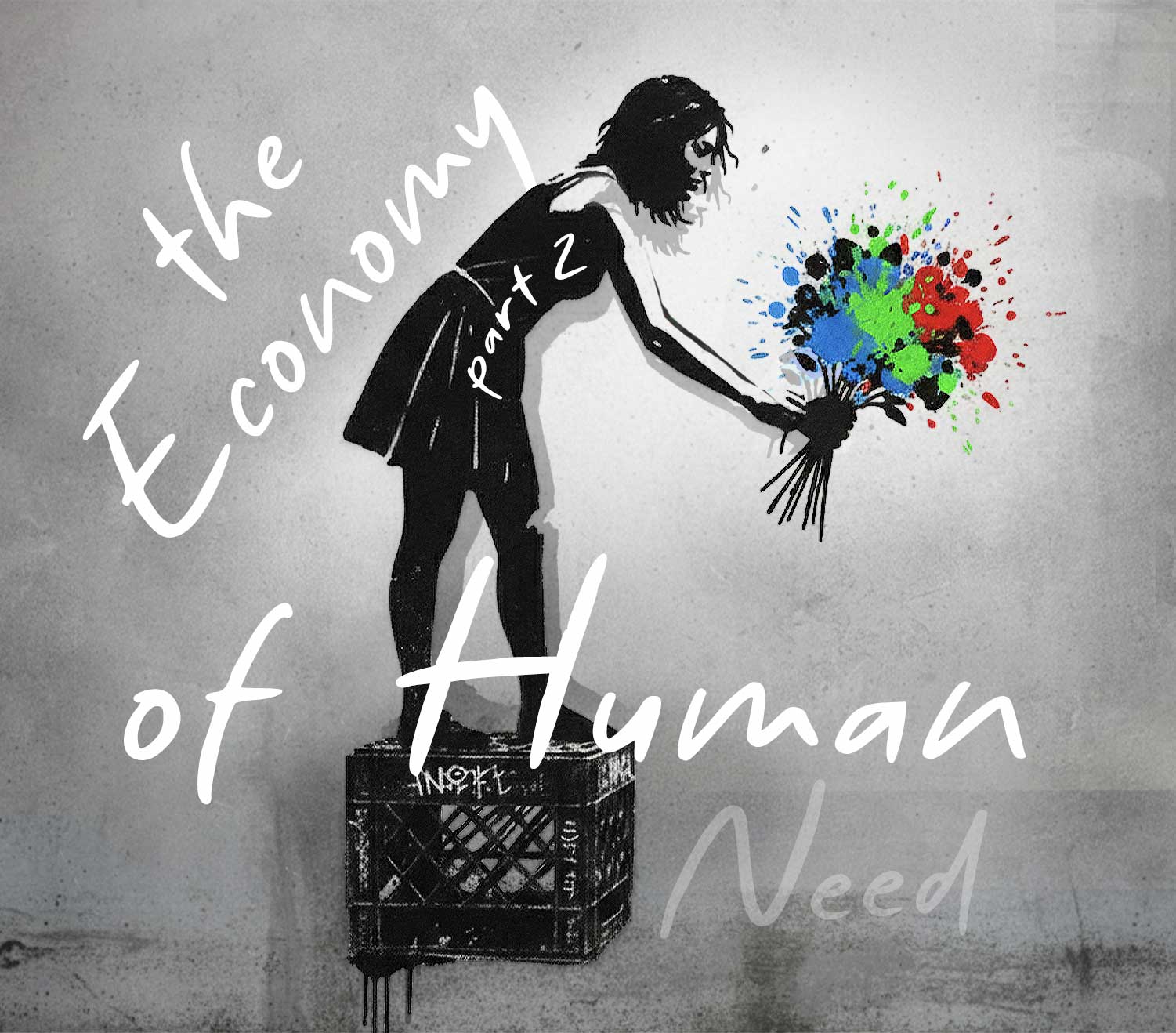
But Amanda walked away from the record label and chose to play a completely different game. She didn't just hire better marketers. She fundamentally shifted from a corporate paradigm to a human one. She stood on her milk crate holding out a flower, asking—not with strategy or guilt or engineered outcomes, but with her whole being. Vulnerable. Waiting. And people responded the way humans naturally do when they realize they're not being played: with love.
I cried watching her TED Talk because it gave me permission to be a little more human in the ways that I ask for help. To look at all the ways I was unconsciously asking "What do I need to say to get what I want from you?" instead of just saying, "This is what I need right now. Do you want to be a little part of my story?" And here's what Amanda understood that her record label never could: she wasn't really asking for money. Money is just a metaphor, and I think we've forgotten what for...
Money is just a symbol that represents leverage to get needs met, but we've gotten so focused on the paper we forget that it's only as good as what we buy with it. We by safety, we buy warmth, we buy nourishment. We use paper as a proxy for what really matters...skin. What we're really exchanging- in addition to basic survival needs- is connection, belonging, purpose, touch. The reason you can have so much money and still be so unhappy is that money isn't a real resource—it only matters if it gets you to the things that do. And the deepest thing that matters is this: we need each other. That need is what binds us. It's the basis of love itself. If we alienate each other in our competitive pursuit for resources, it's a bit like cutting off our nose to spite our face.
But every time we choose to be human first—to be vulnerable in our needs, to open ourselves to genuine exchange instead of competition—we're voting for a different world. One where the measure of success includes reciprocity. Where we define ourselves by trust, empathy, and collaboration instead of by how well we play the corporate game that we now call relating.
The wizard behind the curtain of this #$&*ed up Oz is just a scared old man who cares more for power than peace. And his greatest con was convincing us that corporations could be given the rights of people. The problem is that when corporations start acting like people we create a world where people are forced to start acting like corperations. But we get to choose, every day, in every interaction—are we corporation or human. Will meet the world as pickpockets or with open palms?
Long Form Transcript
Welcome back everyone, my name is Kaelum Gaynes and you’re listening to the Dirty Spirituality Podcast. This is part 2 of our deep dive into the economy of human need. In the last episode we took a look at the difference between having needs…and being needy. We considered whether it might not be the expression of a need that turns people off to helping us, but the hiding of our needs…and the tendency to try and get what we want from others without risking vulnerability. In today’s episode we’re going to zoom out and look at the bigger picture of our economic (and social) structure…and the ways in which it has depersonalized and dehumanized not only the economy of dollar bills, but the social economics that define the exchange of interpersonal resources.
For anyone familiar with Amanda Palmer- who has read her book or watched her TED Talk by the same name- The Art of Asking- you’ll understand what I mean when I say that one cannot rightfully broach the topic of fostering human connection through the vulnerability of asking for help…without due respect given to the patron saint of crowdfunding. If you’ve not at least watched her TED talk- and you’re interested in this topic- just pause me for a moment here and go watch it. I cried the first time I watched it. Then I wept my way through her book. Not because I’m an artist that wants to ‘make it’ and she’s an artist who ‘made it’ with an inspiring story, but because she’s touching on something much, much deeper than the relationship between an artist and their audience. She’s touching on something fundamentally human, and fundamentally broken in our society…which is causing all of us to hide our true selves from the world in order to present a more polished, sanitized, and clickable version of ourselves…in hopes that in-so-doing we’ll be given enough attention to get our deep human needs met.
There’s a moment in her TED Talk where Amanda (also known as Amanda Fucking Palmer, or AFP) tells the audience that after leaving her record label and then proceeding to raise nearly 1.2 million dollars through crowdfunding, in support of her next project, she was often asked the question, “how did you get all that money from people!?” Her answer was, “I didn’t get it from them…they gave it to me.”
For me this touches something deep, and yet also very simple. Which is…that there’s a hard way in life, and there’s an easy way. The hard way is working against each other to get our needs met, and the easy way is working with each other.
Let’s look at it this way…it takes a lot of effort to tell a lie. Because every detail you layer into the narrative has to be accounted for to keep your story straight and avoid getting caught in your invention. You would think that when we lie we would want to keep it simple, and yet when people are hiding something they often give themselves away by providing a conspicuously excessive amount of details. Because when we’re telling a lie we’re oriented around the task of selling what we’re saying...not just saying it. When we lie, we’re evaluating the listener to determine if they’ve yet bought what it is we’re selling. If we’re not sure, we keep talking. Car salesmen are known for talking themselves right past the sale. Which is to say they talk enough to get someone to want to buy the car but then they don’t know when to stop, so they just keep talking until the prospective buyer loses interest. I say this to illustrate the fact that, while the truth is simple, manipulating others is complex…and a lot of work! In the same way that it takes a good deal of effort to tell a lie without getting caught, it’s also a full-time job selling ourselves to get what we want and need from others.
When Amanda Palmer first signed with the record company, they wanted to sell her. The first thing they did was evaluate what she had that they felt could be marketed to the lowest common denominator among the largest subset of consumers within her genre of music. They then tried to reverse engineer her to be as appealing as possible to as many consumers as possible, so they could maximize their profits. Because…who cares about authenticity!? In our world value is only measured in numbers. They told her to stop talking to her fans, to stop building relationships with the people that supported her presently because it was wasting time she needed to be spending appealing to a larger audience. Because who cares about human connection. In our world people are not for relating to, they’re for extracting resources from.
This brings me to where we left off in part one of this episode, looking at the implications of living in a society whose social ethos is defined largely by economic values.
And perhaps- if corporations were defined by things like empathy, reciprocity, integrity and devotion to the common good (which includes the good of employees, consumers and the planet)…it wouldn’t be such a bad thing for people to emulate businesses. But in our world, you get ahead in business by playing dirty. Now I know it’s not that simplistic, and there’s a lot of businesses and organizations doing amazing things in the world. But if you cut our Capitalist society to the quick, what bleeds out is a deeply embedded ethos of eat or be eaten.
The bottom line in business is: how do we get the most money from the most people as quickly and easily as possible, by whatever means will accomplish those ends…so long as it’s legal? And even that is just part of the game, where big businesses would rather allocate massive resources to legal teams who can strategically sidestep the moral mandates of our society, essentially breaking laws and getting away with it rather than honoring the spirit of the law…the clear ideals those laws were intended to protect.
If the easiest, most lucrative way to profit shits all over the environment, if it’s more cost-effective to lose customers from poor customer care than to pay for a good customer service team, if it’s legally passable to work employees in a way that wreaks havoc on their body’s and nervous systems…that’s what most big businesses will do, to a greater or lesser degree. Most businesses are somewhere on the spectrum of a bottom line that isn't a holistic and beautiful exchange of mutual benefit to the consumer and themselves. And while there are businesses in the world I love- like Patagonia- making products that last, working hard to keep their clothes out of landfills, and treating their employees like people rather than resources…businesses like this are still the exception, not the rule.
The current corporate rule has no measure for the efficacy of the exchange beyond the profits accrued. There’s no measure for reciprocity...or social impact. For synergy or sustainability. In this economy, whoever has the most resources to play the game of consumerism against the consumer, is most likely to win. Exploitation for profit (of the earth, the employees and the consumer) is still the rule- not the exception- for this economic model that defines our social structure.
A quick side note: The Book On Fire Podcast has two episodes (Capitalism in a Nutshell parts 1 and 2) that will provide you life changing context through unpacking the history of our current economic model…I highly recommend you take the time to check these out.
Okay, so why the rant on corporate greed? …the message I really want to get across here is that when there is no humanness in the bottom line…when we allow the exchange of resources to become an impersonal endeavor…the organizing principle of our society is not shared vision, dynamic reciprocity or symbiotic thriving…it’s competition. It’s the one versus the many. The cancer that has wrapped itself around the barely beating heart of our social structure…is the unconscious and capitalistic belief…that in the delusion of our rugged individualism…it is us against them.
Now I could give many grotesque examples of corporations behaving this way, but that’s not really the tone I’m trying to set here. If you want to feel depressed about how dehumanizing our economy is, John Oliver, in his show Last Week Tonight, will give you more reasons to hate the world than any one person needs. I would suggest starting with the piece he did on the time-share industry…you’ll need a good shower and maybe some ice-cream after watching that one.
But I don’t want to spend this time talking about things that make me want to eat my feelings, I want to talk about the inspiring examples of courage and beauty in the world which are giving the middle finger to soulless commerce. I want to talk more about Amanda Fucking Palmer.
I’d like to compare for a moment what we’ve been discussing- an us against them model for the exchange of resources, a dehumanizing rivalry of commerce that measures success by numbers alone, a scheming cash grab that will do anything from twisting the truth to snapping it completely in half if businesses believe it will get from people what they’re trying to take...and contrast this with Amanda Palmer saying in her TED Talk, “I didn’t get it from them…they gave it to me.”
Why? Why did people just give her all that money…because she asked. But she didn’t just ask with her words, anyone can do that. She asked with her being… not strategizing, not leveraging guilt or fear or playing any mind games at all for an engineered outcome, she just…asked. And then exhaled in the vulnerability of being a fragile human waiting for an answer. Her ask created a space for others to step into, for others to participate in her story. She asked, heart open, in such a way that to respond by giving didn’t feel like being robbed or manipulated, it felt like investing in human connection, in beauty, in an exchange of resources that brings people closer together, rather than pushing us further apart. People recognized that Amanda was not playing them, she was just being human and in need…without hiding it.
But culturally, we've almost completely forgotten how to be vulnerable enough to just…ask. …To just say, “I'm having some money issues, does anybody want to help?” “I'm feeling lonely today, does anybody want to sit with me for a few minutes?” “I'm feeling touch deprived, will someone rub my shoulders?” It’s with this simple and honest innocence that Amanda Palmer asked her fans for support…and it gives me hope for the world that she was met with just that…an outpouring of generous and eager support from fellow humans who deeply valued not just her music…but her authenticity.
Now it feels worth taking a moment to clarify what I’m not saying in all this. I’m not saying that marketing itself is inherently evil. There is a time and a place to hone a message and present it to a targeted audience with an intended impact. I just believe that if we were doing marketing in a human way, and doing it honestly, it wouldn’t be about manipulating ourselves or others for a desired outcome, it would just be about telling the truth…better. It would be about getting the right message to the right audience so that the people who stand to benefit can find and understand the products, people or experiences that will genuinely make their lives better. There’s nothing socially destructive in asking for attention or with selling you wares… it’s not about what we’re doing, it’s about how we’re doing it.
And how…matters.
For example, there’s nothing destructive about the creation of new tissue in our body’s through the proliferation of cells, but when what would otherwise be normal, healthy tissue suddenly loses the capacity to self-regulate its own process, its development becomes potentially fatal to the larger organism of which it is a part. When tissues proliferate without respect for the homeostasis of the organism they belong to, we call this- of course- cancer. The what that’s happening- tissue growth- is normal. But how it’s happening…is deadly. Cancer is a dis-ease in the body, defined by unchecked growth, which is in competition with, rather than in support of, the very body which is feeding it the resources to grow. The success of Capitalism- at least as it expresses now- is reliant upon perpetual economic growth, no matter the cost…for a society so obsessed with numbers, it shouldn’t be hard for us to do the math on this.
But again, I’m not saying we should burn all our money. Commerce isn't the problem. The problem is simply that the way we’re doing it isn’t human…or, as they say: it’s not personal…it’s just business. The problem is the dehumanizing of our exchange of resources, through the unconscious and malignant collective belief that humanity is a fundamentally competitive- rather than collaborative- organism. Because the truth is, everything that involves a person...is personal.
The way businesses treat people is personal, and the way people treat people is definitely personal. But in today’s world, it’s somehow all just business. Even social media isn’t…social, it’s become a global guerrilla marketing platform…where “influencers” portray whatever lifestyle they think will get them the most followers and then leverage their influence to sell handbags. In a society that has blurred the lines between human and corporation, social media- by and large- has become the marketplace where humans sell…ourselves.
It’s not business it’s personal…is bullshit. It’s all personal!
But somehow we’ve created an economic and social model that sucks the relationship out of the exchange and leaves nothing but numbers. If Amanda Palmer’s record label had any lens to look through that didn’t include dollar signs, they would have seen the opportunity to support an artist in becoming the best version of herself she could be, and then connecting the integrity of that with the fans that would make it lucrative in a mutually beneficial way. In other words, rather than playing against her for the purpose of maximizing profits (even if it choked the inspiration out of the artist and made the music worse for the fans)…they would have collaborated with her…towards a shared good.
Now there are plenty of artists who have had bad experiences with record labels, and then gone off on their own trying to play the same game but better. But when Amanda left the label, she decided to play a completely different game. She didn’t walk away from their corporate scheming and then hire her own slick PR team and a marketing firm, she fundamentally shifted the approach from a corporate paradigm…to a human one. And that’s the answer to the question “How did you get all that money from people?” The answer at face value is that she asked…but the subtext of that statement is…she told the truth of her experience in a way that respected and validated the humanity of the people she was talking to…and they responded the way humans naturally do…with love.
The moment people feel that you're not playing them…the moment they get that you're approaching them not as a corporation, not as a strategist, not as a marketer…but as a human…their guard comes down and you get to play by a completely different set of rules. You get to stop using each other, and start relating to each other.
Marketing and manipulating as the primary dynamics that define most of our daily interactions is exhausting. It’s so much work…when we’re working against each other. Life is hard enough when we’re working together!
But for the most part, we don’t even know we’re doing it. It’s just become painfully normal. As I discussed in part one of this episode, when I launched my first fundraising campaign, I didn’t even recognize that I was doing it, because it’s so interwoven into our culture. It's so unconsciously a part of how we see the world. I had to actually observe what I was doing and be like, Whoah! What’s happening here? It feels normal…but it doesn’t feel right. When I sent the campaign link to friends and the feedback I got was, “looks good! Great marketing!”…I realized I had missed the mark. I wasn’t trying to do great marketing, I was trying to ask for help. But when I looked in the mirror of what I had done, I saw that I wasn't just telling my truth and creating a space for connection. I was unconsciously asking, “What do I need to say and do to get what I want from you?” And that's so much different than just saying, “Hey…this is what's happening. Whoever wants to help, I could really use it.” And that's it. The truth is that simple.
Telling the truth is scary…but it’s easy. Because in reality, we all have only one truth at any given moment. And the truth of our experience, sans lipstick, is usually far simpler than all the ways we try and package it. It turns out when I’m telling the truth- the emotional truth as well as the intellectual truth- there’s far less decisions to make, and when I’m not marketing myself, the inner critic is out of a job. Because there aren’t too many calculations required for telling the truth. There’s something to be said for knowing how much of the truth to share in any given moment (I don’t need to tell my life story to every checkout girl at the grocery store) but whether it’s a few paragraphs or the whole book, the truth is the truth. And when that’s our M.O. in life…there’s nothing to hide, and no one to control.
A week after launching the first version of my fundraising campaign, I set my iphone on a tripod in the field, wood-clamped a little microphone to the handlebars of my bicycle, and recorded a simple, honest (and what felt like naked) ask for help. I cut most of what I had written from the campaign page, because the truth wasn’t that complicated. As of this recording, it’s yet to be seen how this will be received. But inside myself, in the place where the inner critic used to be…telling me I wasn’t persuasive enough, telling me people were going to judge me if I didn’t convince them not to…in that space there is a stillness, knowing I’ve told the only truth I have to tell. “Hey…this is what's happening. Whoever wants to help, I could really use it.”
I cried when I watched Amanda Palmer’s TED Talk (and through a good many pages of her book) because even just listening to her story made me feel a little bit more permission to be a little bit more human in the world. I cried because it gave me hope not only that we can relate to each other with more honesty, love and respect- even within the jungle of our Capitalist society- but that we want to.
And, all of this goes much deeper than just the nature of our exchange with money, if I haven’t made that clear already. Because the economy of dollar bills is ultimately just a metaphor for the far less abstract exchange of resources that defines the economy of human need…things like food, water, attention, touch, belonging, story, purpose, rhythm, ritual, identity and achievement. The reason it’s possible to have so much money and still be so unhappy, is that money isn’t a real resource…it’s just a metaphor for a resource…but it’s a meaningless metaphor if we can’t figure out how- both individually and societally- to get through our use of it…the things that really matter in life.
Amanda Palmer is showing us how to relate to money not as a currency of the abstract (meaningless points in a mental game), but as a currency of human connection, where she gives her fans her heart and they hold it by helping her meet her basic needs in the world, through financial support.
The reason it’s so imperative that our economy of exchange be human-centric, is that it is our need for one another- to hold each other in all the ways listed above- that is the very basis for our very belonging. I had a religion professor and mentor in college who once illustrated the power of need to bring us together by telling the class that whenever he would get into a fight with his wife, he could only dig his heels in until he got too horny to stay mad. His need for sex gave him the motivation to get over his ego and look for resolution. There is nothing more powerful to bind us together as humans than the shared meeting of our mutual needs. It is in the meeting of these needs through which the idea of love is experienced. We cook for one another because we need food to survive. We hug one another because we need touch to belong. The deeper the need we meet, the more intimate the relationship.
Money is just an idea, and that idea can be used as currency for bringing us closer together, or for pushing us further apart. But at the end of the day, what matters most…what will make us happy as humans…is a thriving economy of the meeting of our shared needs…a thriving economy of love. But when financial economics depersonalize our exchange, and a cancerous corporate paradigm hypnotizes us into the inoperable delusion that we are in competition for the meeting of our shared needs, we become disconnected in the deepest comprehensible way. But that disconnect…is a lie.
Humanness is (or is intended to be) a state of interconnected, symbiotic mutually reliant interdependent magic, where many hands make light the work and the reward supports a shared vision and a common good.
And it should be our humanness that defines our economics, not our economics that defines our humaneness. The more we market and scheme and pickpockets to get our needs met the more we vote to remain in a society where the disease of competing against each other for resources is normalized. Conversely, every time we choose to be human first, to be vulnerable and honest in our needs and to open ourselves to a cooperative and mutually empowered exchange of resources...we’re voting for a world where any measure of success contains a metric for reciprocity. Where we have redefined ourselves and the dynamics of our exchange by human traits rather than economic ones…by things like trust, empathy, respect, vulnerability and collaboration to name a few.
It will take some time…to repair the damage of distrust that’s been done while playing by the rules of a world that defines corporate behavior as human behavior, but once we are conscious of the pattern, I don’t think the solution is all that difficult. Amanda Palmer didn’t stop selling her art, she just chose to do it in a way that wasn’t hiding who she is, and that gave others permission to stop hiding who they are. I didn’t take down my crowdfunding campaign, I just cut all the superfluous text and re-recorded the video so there was no slide-of-hand involved…at the risk of being labeled as needy, I let the truth of my current need be seen…along with the fear and grief, and a sprinkling of regret for the mistakes I’ve made to land myself here…not to be manipulative, just to be honest. It is my hope that in this honesty there may be something half as beautiful as Amanda, standing on her milk crate, silently holding out a flower and asking for connection. Not strategizing, not marketing, just…asking.
I feel at peace now, knowing that regardless of what happens with my crowdfunding campaign, what I’ve put out into the world is, if nothing else, deeply human. Knowing that I’ve created an opening for authentic connection by sharing the only truth I have to share, and leaving space for an honest response. And I like to imagine that just as Amanda Palmer’s courage inspired me to remove my heart from the slick packaging of a branded ad campaign for myself, to just hold that human heart out in front of me and share it with the world…that maybe my courage will inspire someone else to do the same. Because the first and only person who needs to give each of us permission to be the hungry, messy, lonely, tired, horny, fickle sacks of deep need that we all are…is ourselves.
My reason for writing this episode is a call to awareness, a call for us all to look at the man behind the curtain and see that the wizard of this fucked up Oz is just a scared and scheming old man, who cares more for power than for peace. And we get to choose, every day, whether we will show up in the world- in our daily interactions with strangers and loved ones alike- as a corporation…or as a human.
Thank you for listening.
Now go fly!