
On having needs vs being 'needy'
Quick & Dirty Summary
We all want to have our deep and human needs met. And we deserve that. The problem is, we seem to have a very hard time acknowledging that we need anything at all. We want to have the proverbial ‘cake’ of our rugged individualism along with the touch and sex and belonging of ‘eating it too’.
Somewhere along the way we all learned that the vulnerability of actually needing someone—and allowing them the freedom to meet that need by choice rather than by leverage—is simply just too risky. So we do something else instead. We strategize. We market and manipulate. We take whatever raw need we're feeling and put lipstick on it... control the narrative, hedge our bets. We turn ourselves into advertisements rather than just being the hungry, tired, horny, messy meat suits that we all actually are beneath the shimmering veneer of our polished personas.
I believe this to be a pattern in our social psyche primarily after observing and dissecting it in myself. I encountered this calculating and strategic protective impulse in a raw and personal way back in 2023, when I was having financial troubles that rendered me unable to make payments on the camper van I was living in. It was the first time in my life that I ever felt compelled to ask the community for support in a big way- via a GoFundMe style campaign- and made me realize I had no friggin' clue how to just ask. How to acknowledge the pain, fear, and vulnerability of my need without strategic overtures or attachment to outcome, and give others an opportunity to step up and meet me in that need.
What came out instead of asking was some form of psychological and emotional wizardry—alluding to the need without naming it, then quickly pivoting to selling, controlling the narrative, anticipating every possible judgment, trying to prove why I deserved it or couching it as an exchange for my art (leveraged by hidden desperation)…anything I could do to avoid just acknowledging my weakness in that moment. That fact is that I had failed. I took a big swing on a business venture, it didn’t pan out and I had run out of savings before the parachute opened. It was a moment I never planned for. Clever as I am, I was out of options and teetering on the edge of homelessness.
I asked a good friend of mine to take a look at the fundraising video I had made for the campaign and give me his feedback. “Do you want my real feedback or do you want me to tell you what will make you feel good?” He asked. I bit my tongue and said I wanted the truth. “Honestly,” he said, “you come off as needy." It was my worst fear. And here's the paradox: it was precisely my attempt to hide the vulnerability of my need that made me seem needy.
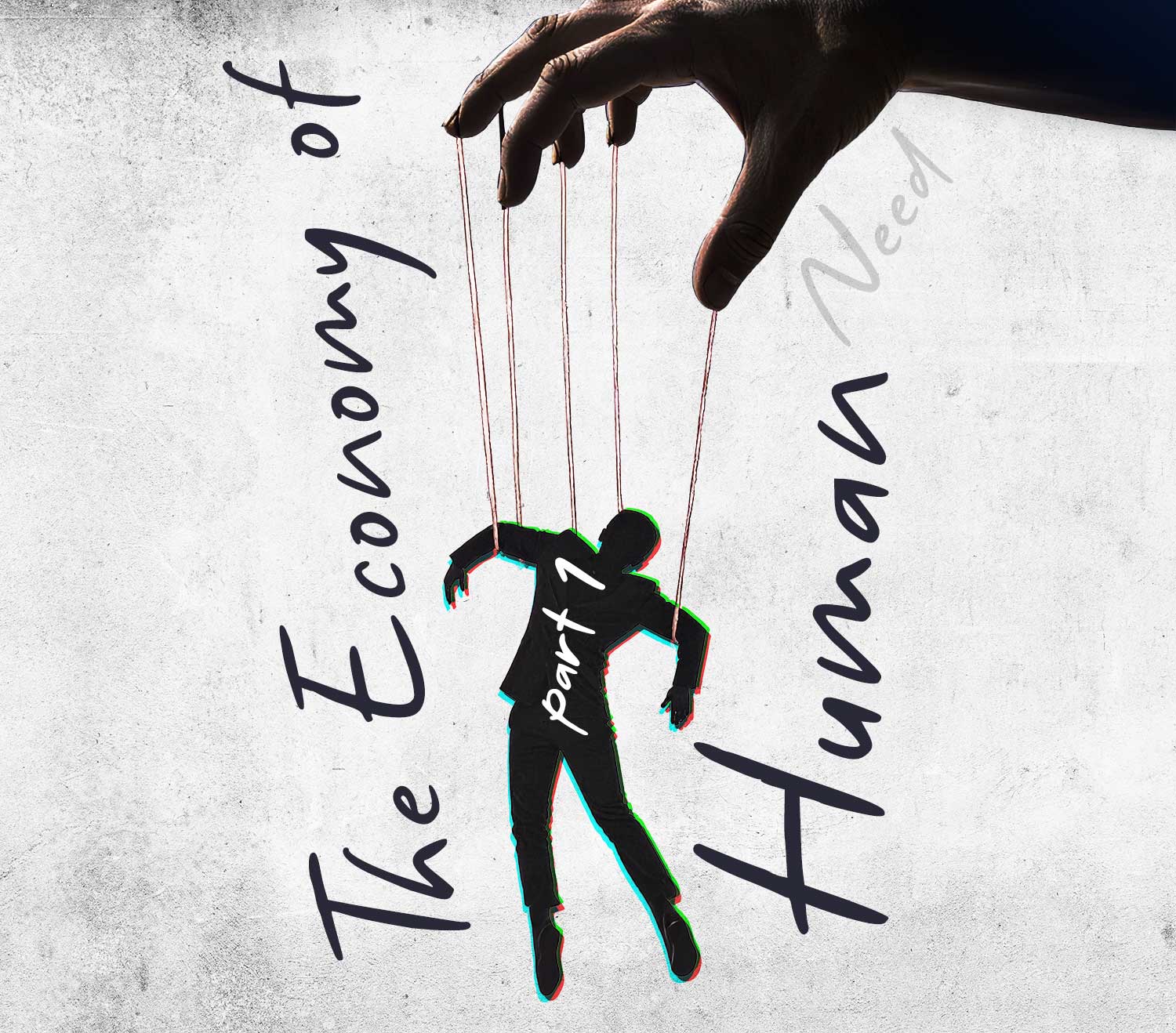
But what does needy really mean? What's the difference between having needs and being needy? What are we experiencing in ourselves when we have the impulse to call someone (or ourselves) needy? I think there's a lot confusion around this that makes many of us feel it is an impossible task to advocate for getting our needs met. But what if it's not actually the weight of someone's deep need that makes us squirm and pull away? What if it's just the discomfort we feel when someone is so secretly desperate that they're unconsciously manipulating us? Pulling invisible strings. Emotional pick-pocketing. Trying to slide their greasy fingers into our psyche to steel some energy or attention without us noticing. But the thing is…everybody notices. Even when they don't know they notice, they notice.
But to actually just ask for something you really need—even so honestly as with tears streaming down your face—is something completely different than the psychological strategizing and emotional chess game we’ve become accustomed to. Really asking, vulnerably, is deeply relational. And it creates space. Space for someone to willingly step in and meet you there...or not. Space to give the gift of their love through touching the rawness of that need...or not. It's the '...or not' that terrifies us. Because for that space to really be spacious, there must exist the uncertainty that comes with the sovereignty of another. But it is ultimately only with the true freedom to say ‘no’ that a ‘yes’ is even ever possible. And paradoxically, when we feel pressured or manipulated our natural response to that forcefulness is the desire to assert our boundaries with a ‘no’. But when we feel fully allowed to say ‘no’, we are simultaneously allowed to feel our hearts swell with the love and compassion that motivate an authentic ‘yes’.
The problem is, asking a real question and leaving the space where the answer belongs to be completely and horrifyingly empty—that's profoundly vulnerable. And if we cannot muster the courage to be with that uncertainty, the only alternative is a relational chess match. Because there is a false kind of comfort in the illusion of control, even when it's actually costing us the connection we crave most.
But if we can be in that vulnerability, the world is our oyster! Because although there will always be people who say 'no' to our bids for shared resources, it's my belief that there the world is filled with people who are actually hungry to say YES to clean, safe, respectful bids for the exchange of resources that we alternatively call giving and receiving love.
Because need isn't a disease. It's inherent to being human. We are an interdependent organism and all these needs bind us to each other and to the earth in painfully beautiful ways. We feel thirsty because we need water. We feel hungry because we need food. We feel "needy" because we need each other to survive. The disease isn't the need—it's the hiding of the need. The disease is the rugged individualism that taught us a myth of self-reliance and competition over collaboration.
Quick & Dirty Transcript
Hello everyone, my name is Kaelum Gaynes and this is the Dirty Spirituality Podcast. Today we’re going to talk about human need, the fear of being perceived as needy, and how this fear informs the messy, often manipulative economy in our exchange of interpersonal resources. We’re going to ask and answer a question that I think looms large for all of us in our own way, that question is- what’s the difference between having needs…and being needy.
I’m going to unpack this within the context of my own experience in trying to find the courage to ask for support, with naked vulnerability, in a time of need. In this episode we’ll also crack the door to the larger idea of how the exchange of resources- perhaps the most vital interpersonal dynamic defining the human experience- both informs and is informed by the diseased state of our fiscal economy.
As a poet, I make work of telling the truth. It’s my chosen vocation to draw attention to who we are, as humans and as a collective, underneath the latest fashions in bullshit that we cover ourselves with because we believe it gives us the leverage to get our needs met. And at the end of the day, that’s all we all really want…is to get our needs met. And we deserve that. We all deserve to have our needs met. But a problem arises when we buy into the false dichotomy that says we must choose between authenticity and influence. That we must be either ourselves or the walking advertisement for ourselves that we believe is more likely to get us what we want in the world.
As an artist, it’s my job to take the lipstick off. To find the truth and beauty inherent in the deep vulnerability of the human condition. But recently- I’m a little embarrassed to admit- I caught a glimpse of myself in the mirror of those closest to me, and what I saw was not only a pair of smackers cheek to cheek in sex-red lipstick, but a full face done up and doing my best to sell myself.
Recently, I launched a campaign to raise the money needed to pay off the camper van I’ve been living in, at the risk of needing to potentially sell it otherwise. But what I want to talk to you about in this episode, is what I’m learning- in realtime- from the Goliath task of asking for help. And when I say Goliath, I’m not referring to the outward logistics of recording a video, writing a campaign summary or sharing a link; I’m referring to the internal crucible one must be melted in- or at least that I needed to be melted in- before I could find it in me to strip myself naked and just tell the truth. The vulnerable truth of my authentic need for other humans to hear with their hearts and respond to in whatever way they might be moved to do so, in lieu of a strategically contrived version of myself, optimized for clickability and conversions.
In the first version of the campaign I launched, I didn’t tell the truth. Not in the sense that I was willfully misleading or twisting facts. No. What I mean to say is I didn’t tell the emotional truth. I created that first campaign as a marketing expert. And while I’ve actually spent over a decade as a paid professional helping people market their brands and businesses, I’m gonna go out on a limb here and say, in this culture, we’re all marketing experts. Because if you think about it, all marketing is…is to be strategic in our expression, to reverse engineer whatever it is we’re presenting to the world- this even applies to how we present ourselves- in order to achieve a desired outcome.
Marketing starts with the what. It asks, what do I want from others, and then it lets that determine the how…how we show up in the world. We all spend a lot of time and energy entertaining this inner critic. And all the inner critic is, is our internal marketer. The voice that says, If you want to get those clicks, sugar, you better put a little more lipstick on it. The inner critic is, at heart, a strategist. Our own personal PR liaison, giving us real-time reflections on how we need to be different if we are going to get what we want in the world.
But what’s the alternative to marketing ourselves? As we’ve already established, we all have needs that need to be met, and it’s just a sobering fact that the meeting of most of those needs require something from someone else. How do we get others to want to meet us, without tricking or manipulating them? Without working against them, but rather working with them? The answer, I think, would be incredibly simple to a child. But through all the layers of cultural programming we’ve inherited- and all the crazy shit we’ve come to call normal in the way humans relate to each other- we’re gonna need to unravel a few things to see it clearly. Let me start by briefly unpacking my current need- the catalyst for this episode- and then we can use that to further explore the topic.
When I created the first version of my fundraising campaign, what I presented was an advertisement for an authentic human that in my strategic brain, I thought was most likely to achieve the desired outcome- to get my needs met- which in this scenario is a need for financial support in order to preserve the stability of my living situation. I didn’t tell the raw, simple and heart-swallowing truth of my experience…of my need. AND, I didn’t even really clearly ask for the help I’m hoping for. I’ve been in a lot of tight spots in my life- financially and otherwise- but I’ve always managed to find the rip cord and pull it to release my parachute before hitting the ground. Now here I am, in a free fall towards earth, close enough to the ground that I can see the leaves on the trees…getting serious enough about the situation to wonder: if I asked…would anyone catch me?
And is it even a fair thing to ask? Knowing everyone has their own problems, their own fears, their own impending crises. Is it reasonable? Is there an appropriate time in life to swallow all my pride and shout from the rooftops the (for some reason) embarrassing truth that I don’t have it all under control. That despite my best efforts I made mistakes (clear in hindsight) which led me down an unlit path that’s not on my map. If I were really stuck, I think to myself, would people understand the ask? Or would they just look at me and say, “we’re all struggling buddy, but the rest of us have the decorum not to show it.” And, perhaps a bigger question, if I were to ask for help, would I even know how? Apparently not. Because on my first try, gun to my head, I still didn’t find the courage to just tell the truth. To just…ask.
I alluded to the fact that I could use support, and then quickly diffused the tension of being vulnerability-adjacent, by shifting gears into selling. Selling my art, selling myself, writing pages and pages of ad copy, trying to control the narrative, trying to anticipate whatever judgements people might have of my situation, whatever objections they might have to my ask, layer upon layer of strategizing, to control your experience of me. Believing that if I could just do that, I could get from you what I want…what I need. Which is simple, really, a few moments of attention, a little bit of love, a couple bucks in a hard time. But I couldn’t seem to own the fact that that’s what I needed, that that’s what I need still in this moment. So I just danced around it. An interpretive dance that no one who doesn’t already know me had any clue how to respond to.
A few weeks after launching the fundraiser, having shared it with quite a few people, receiving a much less enthusiastic response than I would have anticipated (for all my marketing savvy), and desperate for understanding, I asked a friend for feedback on the campaign. The first thing he said was, “Do you really wanna know?” In that moment I’m pretty sure I felt my heartbeat in my testicles. I had two weeks left to raise the money I needed (now a little less than that), all my hopes were riding on this campaign, and he was about to tell me the thing I was most afraid to hear, “To be completely honest,” he said, “you come off as needy.” I wanted to find the nearest rock so I could crawl under it and die. Releasing that first campaign was terrifying for me. It was terrifying because I had the story in my head that if I asked for what I needed, people would think I was needy. I spent a full week strategizing to market the campaign with one unconscious goal in mind…ask for help, but don’t get caught being needy. In other words, ask for help without asking for help…or get your needs met without being vulnerable.
I wasn’t asking for help and then listening for the answer. It’s debatable if I was asking anything at all so much as just hoping that people would see me flailing around and offer help. But wherever I was on the spectrum of asking, I certainly wasn’t listening. I was doing what we’re so programmed to do, what comes so naturally, I was trying to manipulate the outcome.
Why do we manipulate? In the 2010 film “How Do You Know”, there’s a scene where Paul Rudd’s character asks Jack Nicholson’s character- playing his father- a question that has stayed with me for years. He asks, screaming at his dad, “Have you ever in your life asked a question that you don’t already know the answer to!?” There’s comfort in control. There’s comfort even in the illusion of control. We manipulate others- even subtly and unconsciously- from the fear that if we leave the meeting of our needs up to chance- letting ourselves feel deeply reliant upon the good graces of another in their sovereign whims- that we might not get our needs met…and that it’s too much to risk.
It’s too vulnerable to really rely on others. To trust in anything or anyone beyond ourselves. So by the time we verbalize an ask for anything from someone else, we’ve most often already positioned our bishop and our knight- in whatever chess game of relating we are playing with the person in question- to put some premeditated (if not simultaneously unconscious) manipulative pressure in the direction of the response we’re aiming for. Which is to say, when we’re too afraid to be vulnerable, there’s a lot more strategy than there is curiosity in our bids for connection and support. We rarely ask questions, especially when there’s risk of rejection, for which we don’t already know the answer…or haven’t at least already heavily hedged our bets.
To ask for something we need from someone else, and leave the space where the answer belongs completely, vacuously, horrifyingly empty…is profoundly vulnerable. But it’s that empty space, that leaves room for the other person- in their own individual sovereignty and grace- to truly meet us. In the first run at my fundraising campaign- without really being conscious of what I was doing- I had asked a question without really leaving space for an answer. In my attempts to circumnavigate the vulnerability of showing my need- and leaning into the freewill of others to meet it (or not)- the end result was an unconscious kind of manipulation. Because any attempt to control someone’s perception or reaction to you without their knowing it…is a form of manipulation. And this is what my friend was reflecting back to me when I asked him for his feedback. He helped me connect the dots on something, which is that it was paradoxically my attempt to hide the vulnerability of my need…which gave him the creeping feeling of me being needy.
What I was hearing my friend say in his reflections of my initial campaign was essentially that he had caught me in the lie…of myself. My greatest fear in launching a fundraising campaign and asking for support, was essentially that I would get caught in the hidden vulnerability of my need, and perceived as needy.
But what does it mean to be needy? I think we all tell ourselves some version of the story that expressing a need is needy. That letting others feel the impact of our struggle with an unmet need...is needy. So we take all our needs and we package them, then we market them. We sanitize them and we pretend it's no big deal. We pretend we’re not all the hungry, messy, lonely, tired, horny, fickle sacks of constant need that we would all easily be if left to our own devices. But need isn’t a disease, it’s inherent in the nature of the interdependent organism of which each individual human is just a single cell. The organism is meant to thrive in reliance upon its other parts, in the same way that the cells in my lung tissue rely on the work of the cells in my heart. We feel thirsty because we need water to survive. We feel hungry because we need food to survive. And we feel “needy” because we need each other to survive. That’s not inherently a problem. But it becomes one when we fall under the spell of a rugged individualism whose doctrine is a devotion to the illusion of self-reliance.
Fact: we don’t become any less needy just because we’ve chosen to believe that we shouldn’t need anything from anyone. The truth is that everyone…everyone…is marked at their core by a deep and abiding need for resources- physical and immaterial- which defines our relationship to each other…and to our planet. When we start pretending that is not true, there becomes a cause for dis-ease. Not the disease of need, but the disease of hiding our need.
Hiding the man (or woman) behind the curtain of a dispassionate veneer who is scheming to try and figure out how to get all these deep needs met without letting anyone actually catch us in the act of needing them. Without being vulnerable. And I would wager that whatever it is we're feeling from another person when we label their behavior “needy”, it's not actually the weight of their need but rather the discomfort we experience in our bodies when we feel the deep need in another that they themselves are not being honest with us about. I think neediness is what we call it when someone is so secretly desperate for something that they are unconsciously playing us, pulling on us, ever so subtly manipulating us to get what they need...without just asking for it. We believe that if we show others the emotionality of our struggle, they'll feel manipulated by this. But to ask- even with tears pouring down our cheeks- is honest. The reason the honesty of the ask feels (to those on the receiving end of it) so much safer than the hidden need secretly pulling strings that aren't as invisible as we’d like to believe, is that when we own the truth of our experience- even if that experience is desperation- we're taking responsibility for ourselves. So I'd like to challenge the belief that expressing our needs is needy, and suggest that maybe what's actually needy…is not expressing our needs.
Because everyone feels the man/woman behind the curtain of our hunger, silently begging for something that we're somehow not actually asking for. When we do ask, when we really ask, and we listen for the answer- in full acceptance of whatever that answer may be- something magical happens. Something that isn’t business…it’s personal.
When we ask a question for which we do not already know the answer, we’re creating a space and safety for others to meet us in that need. Because when all is said and done, in any area of life, it’s the confidence that we can safely say ‘no’ (without fear of punishment or the loss of connection) that creates in us the comfort- which often leads to the desire…to say ‘yes’.
I think people actually really like helping other people when they have the resources to do so. There's a deep interpersonal reward of human connectivity that comes from stepping into that space of need that someone has been vulnerable enough to open to us, that comes from meeting them there and giving the gift of our love through the touching of that need. But when we aren't vulnerable, when we don't honestly ask, we're not opening in ourselves a space for anyone to willingly step into...we're just pushing people around while pretending that we're not.
There's no joy in giving- for the other- when it doesn't feel like a gift. When it feels like...petty theft. Trying to get needs met without getting caught in the vulnerability of our humanness makes us into emotional pick-pockets. Trying to slide our greasy fingers into the purse of someone else's interpersonal resources without them noticing. But the fast and hard truth here is...everybody notices. Even if they don't know they notice, they notice. When we feel it strongly enough to put words too, we may be so inclined to call our experience of those greasy fingers…needy. But it's not the having of a need that makes us needy, it's the hiding of it.
When I launched my first campaign, I was terrified of the vulnerability of asking for help, admitting weakness, and altogether uncertain if I was even worthy of such support. And then, I did what we do. I painted all this fear and insecurity to create the illusion that I wasn’t vulnerable, that I wasn’t afraid, that I was available for support but not really asking for it. (After all, how can you be perceived as needy if you don’t admit you’re in need?) In short, instead of an authentic and heart-swallowing bid for human connection through vulnerability and receptivity to the intimacy that comes from the meeting of shared needs, I created an advertisement for the opportunity to help me…strategically marketing myself, rather than simply being myself.
Going deep into the belly of the whale of the feelings cascading through my body as I accepted that one of my deepest fears was playing out in front of me, I started asking myself how I got here. Why was it so easy to behave this way despite my every intention not to?
There’s a cultural program here, in the chronic and systemic marketing of ourselves. It’s so easy to do because it’s so normal in our society. It’s embedded in our psyches. Why? Why is it easier for us to be advertisements for ourselves than it is to just be ourselves?
It could have something to do with the fact that we live in a social structure that’s based on an economic model (ie: Capitalism). That we live in a society which has granted corporations the rights of people. It stands to reason that the more we treat corporations like people, the more people will need to start acting like corporations.
More on this in part 2 of this episode.
Thank you for listening.
Now go fly!