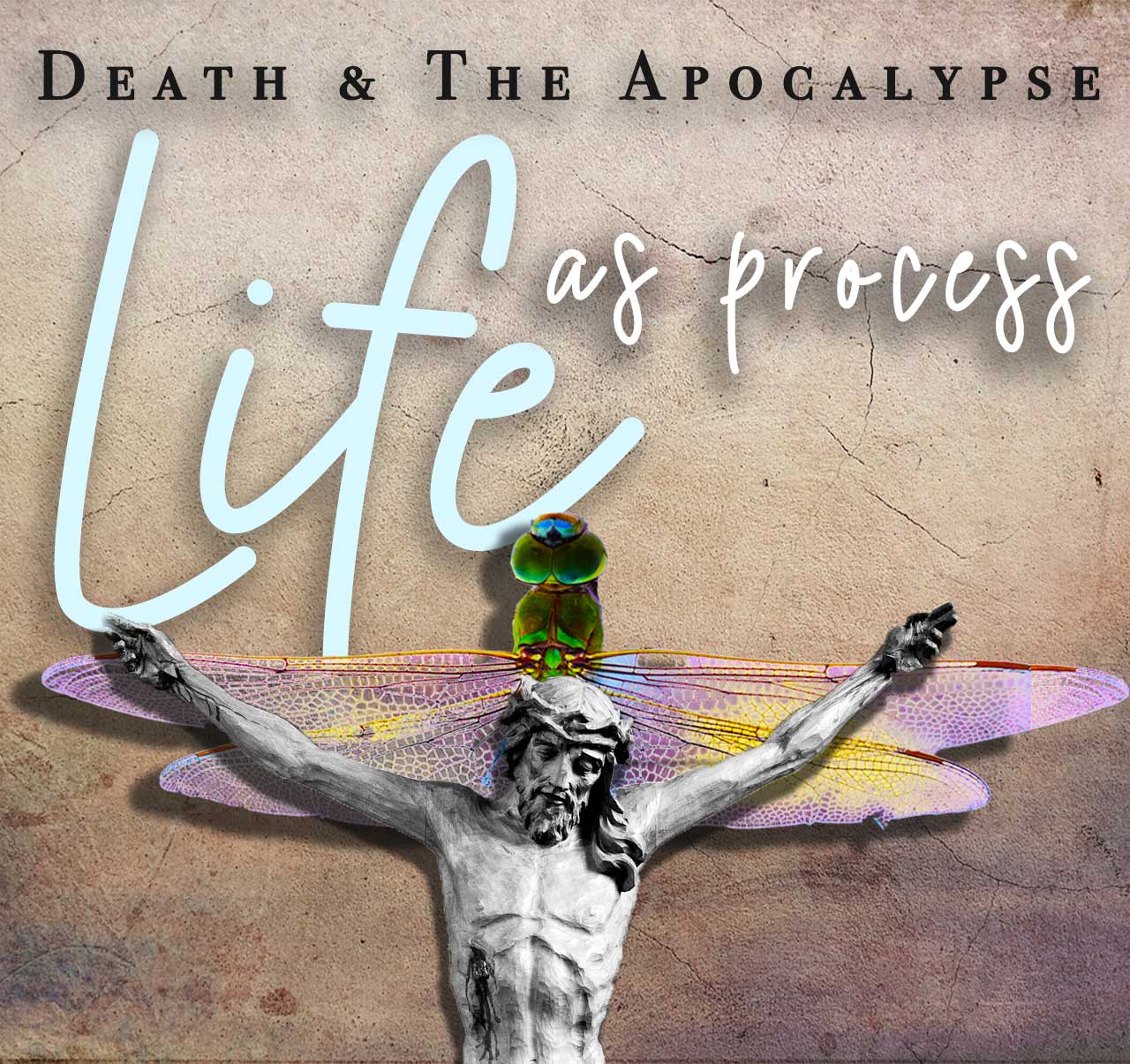
![Death & The Apocalypse [Philosophical Preface]](/content/images/size/w1600/2026/04/LifeAsProcess.jpg)
Life (and death) as Process
Quick & Dirty Highlights
When we talk about death, what we're really talking about is life as process. Not the end of life, but one critical phase in the cyclical, iterative nature of consciousness and everything experienced within it.
Our current paradigm thinks about death in a falsely linear way—product over process. But life— even literally if you look at our cells, our planet, our mother's belly when we're in the womb— is circular. Life is process. And we all get to decide how fiercely we'll engage with that process, how deeply into the catastrophic beauty of life in a body we'll descend…that we may ascend as something altogether new.
There's a key distinction here between culmination and completion. Culmination is eminent—it requires no courage and is not something we do but something that happens to us. We were born, we will die. There are bookends on our lives no matter how you slice it. But completion is a measure of what we do and who we become in between those bookends. In completion there is artistry, mastery, risk, upheaval, transformation.
Think about the people we revere for being wildly alive—Bruce Lee, Jimi Hendrix, Joan of Arc, Martin Luther King Jr., Gandhi, Jesus. You'd be hard-pressed not to notice the pattern: they all lived somehow closer to death than most. Many died young. We speak of them not for their biological longevity but for the awe-inspiring process of their lives. For their courage, creativity, the divine spark they expressed. For how profoundly they changed both themselves and the world.
Because here's the truth: to become the bright new being who is the completion of the life process unfolding within us, we must die as the contracted, scared, silent, rigid version of ourselves we currently know ourselves to be. Whatever our soul's next developmental task is—that's our dharma. And when we're courageously engaged at our growth edge within that process, we feel as full of life as one can get. Even if—and make no mistake it will—it kills us.
The difference between culmination and completion is the only existential choice we have. We don't get to decide when or if life ends. Only the quality of the process we embody within the time we're given.
And yet most of us spend enormous energy moving through our lives—ever closer to our deaths—without feeling the weight of that existential proposition. The ending of the play is actually an inextricable part of the story, providing critical context for everything that unfolds between the raising and lowering of the curtain. Without this context, we get strangely lost, pretending to be infinite beings in a finite world.
This is why Buddhists make work of contemplating their own deaths. For most of us, contemplating death feels morose, pathological. And for a long time on this planet, whether we contemplate our own death has been a choice—because when the collective organism of terrestrial life is humming along with relative ease, one must choose to contemplate death. We're left to the blissful ignorance of pretending, from the spring of our lives all the way to the whimpering edges of winter, that we'll live forever.
But what happens when the collective organism of terrestrial consciousness is not humming along with relative ease, but is itself slipping into the first frosts of winter?
When the contemplation of death ceases to be an elective activity for the spiritually inclined and becomes an unavoidable expression of our collective awareness—I would venture to say we are in apocalyptic time.
...BUT let's redefine our associations with that word, because it's a big one. Please continue on to primary content for this episode: Death & The Apocalypse: The Gospel According To A Dragonfly.