

The Gospel According To A Dragonfly
Quick & Dirty Highlights
For as long as I can remember, the world has been ending. And while in some ways this is true for all of us—the moment we take our first breath we've already begun inching toward our last—for me it's been true in some uniquely bizarre ways.
I was raised in a fundamentalist home by a father who made a series of mainstream films about the end of the world, the second coming of Christ, the mark of the beast, and the antichrist. I wasn't told growing up that Santa Claus took those bites out of the cookies. I was taught that I was living on a planet moving toward a moment where trumpets would blast from the skies, everyone who had prayed the prayer would vanish, leaving their clothes behind along with all the non-believers as the world descended into chaos, ruled by the antichrist who would force everyone to get a computer chip implanted in their foreheads, and if they refused…they'd get their heads chopped off.
So I'd like to think I know a thing or two about the apocalypse.
These beliefs—which fill the mind to the brim with fear, leaving no room for love—led me into an existential crisis and clinical breakdown before even graduating high school. How does one justify spending the hours left of their life playing with noise when, in their body, the world is ending? I ended up getting my degree in historical theology and philosophy because I couldn't focus on anything other than these horrifying uncertainties about the nature of reality, good and evil, God and the Devil.
By my sophomore year of college, I was so physically and mentally sick I could barely get out of bed. I would slip into altered states from the chaos in my mind and body, malnutrition and sleep deprivation paired with chronic inflammation in my gut and brain. I would lay in my room in the dark for days, hiding from an impending fear I couldn't give words to. On my worst days, I began to hallucinate what appeared to be a dark being standing at the foot of my bed—what I interpreted through my fundamentalist lens as a demon. A vacuous, blackened silhouette I could scarcely look at. I would just hide under my covers, waiting for it to go away.
Then one day an art therapist friend invited me to make a diorama of the scene. When I cut the dark figure from black construction paper and glued it to the base of the shoebox, I suddenly saw it differently. Not as a being, but as a doorway. A portal that could be walked through. I had been slowly developing a theory in my theological studies: that the Devil isn't real—it's real in our experience so long as it's believed in, but ultimately it's a personification of fear. An externalization of those internal aspects of self we can't bear to look at. In the words of Carl Jung, the Devil is a personal and collective shadow within the human psyche.
My theory was that Jesus didn't come to save us from the Devil by pushing it further away, but to save us from the illusion that the Devil is something other than ourselves. He did this not by vanquishing the darkness but by integrating it. Not by resisting death but surrendering to it. My theory was that underneath it all, there is nothing but love.
So one day, in the darkness of my basement room with the windows blacked out, the figure returned. After hiding under my covers whispering "the Devil isn't real, the Devil isn't real," I finally worked up a flash of courage—literally a second, maybe two—and mobilized my body through that doorway.
The moment my body passed through that space, I dropped to my knees. For the first time since my sophomore year in high school, I broke down sobbing. For hours I wailed. I wept until the blood vessels around my eyes began to rupture. I wept until I couldn't breathe from all the snot. I wept like a dying animal in ways that would not be recognizable as human. In the darkness, in the fluids pouring from my face, my mind watched like a movie—so many things that had happened in my early life that I had never allowed myself to feel. I wept until I passed out into a deep, dreamless sleep.
When I woke up, I felt something I hadn't felt in years—not sick. I felt present. I felt alive again.
And I couldn't help but recognize that what had given me that new life was finally surrendering to death. That what had held me so close to death for so many years, frozen in my body and nervous system, was my resistance to death.
That was the beginning of a healing journey that would span decades. It was an experience of my theory—that just below the surface of chaos is an organizing principle, like Christ, like Ganesha, like Isis, bringing all things back together again.
Here's what I've come to understand: we're so afraid of death because we tend to imagine it as an ultimate sort of end. A non-being. In this scary story, life and death are altogether separate, even antagonistic. But the gospel of Christ as I read it is not a gospel of alienation—it's a gospel of reconciliation. Jesus showed the world not how to be good but how to be whole. Jesus embraced and integrated the opposites of everything we cling to. Where we fetishize pleasure, cleanliness, control, wealth, and life itself, Jesus embraced agony, filth, surrender, emptiness, and death. Not pushing the darkness further away but bringing it back home into his very body. Jesus showed us that death is not an end—it's just part of a process. Death is a part of life, not the enemy of it.
Within this context, death holds within it the richest, blackest, most fertile soil from which the seeds of life spring forth. Because life is fundamentally a process, and all processes are iterative. Death is inextricable from life. One cannot fully live without the courage to fully die.
And though death is inevitable, life is equally inevitable. One cannot live without dying, but one also cannot die without being reborn. Life is the beginning of death, and death is the beginning of life, of resurrection. Suffering exists not in life or death but in stagnation. It is ultimately only the resistance to death that immobilizes the process of life.
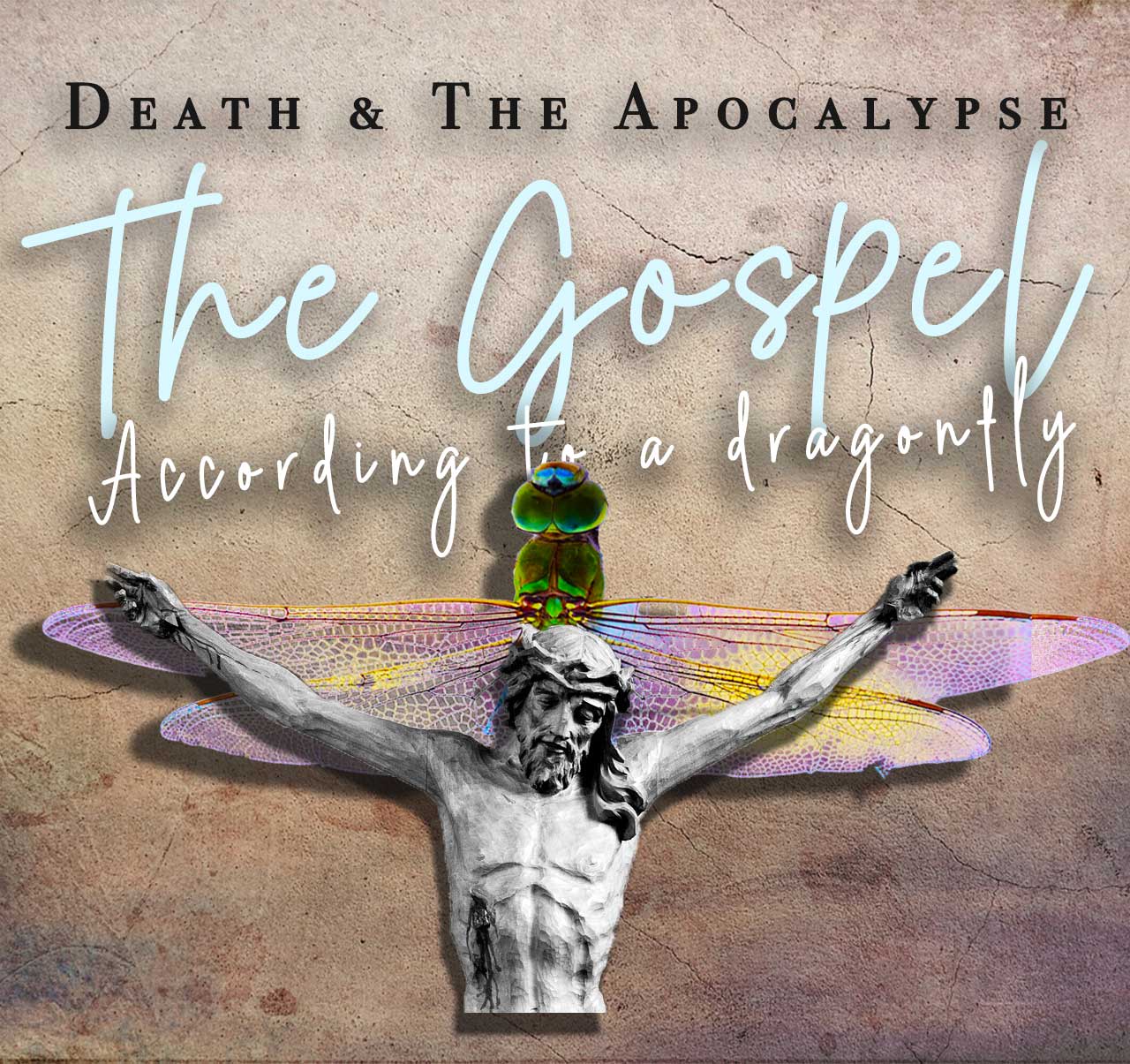
The dragonfly can teach us as much about the gospel as Matthew, Mark, Luke, or John. It starts its life as an aquatic insect with no wings, unable to survive above water. Eventually it musters the courage to do something that would seemingly be the death of an aquatic insect—crawling up out of the water into air and light, where everything it has ever known itself to be will dry out and die, becoming brittle enough for the shimmering winged insect to peel itself from that brittle dead body and take flight. The gospel that death is not an end of life, only the end of one phase in an endless process.
If we are living life well, we will be dying all the time. Dying gracefully. Children go off to college and a mother whose identity is inextricable from caring for her offspring must die. Divorce. Marriage. The loss of a job. Moving to a new city. Winning the lottery will kill the self whose identity is rooted in economic tension. The healing of a chronic disease will kill the self whose identity is rooted in the frailty and confines of that limitation. If the sick person is unwilling to die—unwilling to let go of the identity around that sickness—the process that could give rise to a healthy person is paralyzed.
As Ernest Hemingway wrote: "The world breaks everyone and afterward many are strong at the broken places. But those that will not break it kills."
The original Greek root for apocalypse is a verb meaning "to uncover or to reveal." Kate Bowler beautifully defines it as the "bright clarity of approximate ending." For the dragonfly, its transmutation from aquatic nymph to airborne sprite could easily be called an apocalypse—the revelation of what has been hidden, the uncovering of wings, the laying bare of an altogether new creature.
Apocalypse, like death, is as much a beginning as an end. The only question is: will we have the courage to step into that new beginning? To walk across the threshold of death that we may arrive at new life?
Looking at death through the lens of love rather than fear offers us a radically different image. It changes us, in our relationship to death, from victims to explorers.
Kate Bowler says, "everything comes undone…everything gets put back together." The grace is in learning to allow it.
My faith is not that if I'm good enough I will live forever as this. My faith is that I am already enough…and I am forever becoming. My faith is not in life. It's in death. My faith is that the endings of all I've ever known could not possibly be anything but the beginnings of something beyond the limits of my finite human comprehension.
********************
Again
Become
what you've never been…
what only time and touch
and the faith that what breaks will mend
can make you.
And when that is done…
End.
But don't just end
…end well.
End the same way you began,
different only in what you've become.
Dream your last dream in the silk sky.
Let the empty air fill your hollow body
one last time.
Let those green lit blades do their work
to break you
down and back to that
black and heavy earth
that not so long ago
spit you out.
Let it feed itself again.
Because a beginning is only as good
as its end.
Then,
if in life you found it in you to believe
that all that breaks will mend,
take a deeper breath yet
and know that all endings begin
again.
[from the book: When The Gods Were Half Human by Kaelum Gaynes]